Ask the Referees!
Riviera Golf


Lorenzo Esposto has been a golf referee since 2010 and a national referee since 2015. Throughout his career, he has officiated dozens of regional and national tournaments, as well as a couple of international competitions. He is also the head instructor for the Rules of Golf in Zone 4, which includes Emilia-Romagna and Marche. Over the years, he has introduced hundreds of beginners to the game through the “Rules of Golf” exams.
He chose to become a referee to combine his profession with his passion for the sport, finding in officiating a way to truly live golf.

Ubaldo Battarra has been a golf referee since 2015 and, since 2023, a national referee. Throughout his career, he has officiated dozens of regional and national tournaments, building solid and widely recognized experience. He is also a Rules Official instructor for Zone G, which includes Emilia-Romagna and Marche, and serves as a consultant for Riviera Golf. Over the years, he has introduced hundreds of beginners to the game through the “Rules of Golf” exams.
For him, officiating is not just a technical role, but a way to experience golf in every aspect. This journey allows him to deepen his understanding of the game, combining expertise and passion in a path of continuous growth.
Mauro’s Question
If the ball is in an area of the bunker where there is grass (on the wall/edge) and the ball itself is lying on top of it, is that still considered a bunker?
Is the grass considered part of the bunker, or can I drop the ball onto the grass?
The Referees’ Answer
Dear Mauro,
if I understood correctly, the ball is on the wall/edge of the bunker and therefore, as shown in the first image attached, it is not considered to be in the bunker. However, I am not sure whether the ball is embedded or not.
From the way you describe it, the ball is resting on top of the grass, so it is not embedded. In that case, my first question would be: why would you need to drop it?
Have you declared the ball unplayable, or is there another reason?
For example, if the entire bunker had been declared Ground Under Repair (GUR) and your feet were inside the bunker while making the stroke, you would be allowed to take relief by finding the nearest point of complete relief. From there, you would have one club-length, and in this case you would drop in the general area (grass).
On the other hand, if the ball, as shown in the first image, was resting on a grassy spot within the bunker area, it would not actually be considered in the bunker, but it would still be important to understand why you wish to drop it.
If instead the ball is embedded, I have attached the image showing the correct procedure to follow.
With the information I currently have, I cannot be more precise, but I hope my explanation is clear.
Renato’s Question
In a Louisiana format hole (let’s say a pairs competition), if both opposing players play the wrong ball and only realize it two holes later, what happens?
The Referees’ Answer
Dear Renato,
thank you for your question.
First of all, it should be clarified that the Louisiana format is not specifically covered by the Rules of Golf. Therefore, each competition may have its own local rules, depending for example on the number of players or how many centimeters the ball may be placed after choosing the best shot.
However, since the game is still played on a golf course, the Rules of Golf are used to manage any situations not specifically addressed by the competition’s local rules.
In this case, it would be important to better understand the exact situation because, in this type of format, the players forming the “side” choose the best ball — meaning the best position from which both players will play the next shot.
Speaking about a “wrong ball,” and without knowing all the details, I assume that the selected ball was not actually theirs. Therefore, by choosing that position, they may have played from a wrong place rather than having played a wrong ball. This is because, even if the lifted ball was not theirs, once the ball is placed it may be substituted, and therefore even the lifted ball could technically have been used for the next stroke.
At this point, it is necessary to clarify that, having played from a wrong place, it must be determined whether the breach is considered serious — meaning whether it significantly advantaged the side. In that case, the mistake should have been corrected, otherwise the penalty would be disqualification.
However, since they only realized the mistake two holes later, the error was not corrected in the case of a serious breach.
If instead the breach is considered minor, it must be determined whether the two penalty strokes were included on the scorecard. If they were not, the side returned an incorrect scorecard, which in this case also results in disqualification.
I hope I have explained the situation clearly enough, although the limited information available does not allow me to fully analyze the case.
Of course, if additional details become available, the situation should be reassessed accordingly.
Gilberto’s Question
My ball ends up in a dropping zone. This area is carefully mowed and clearly marked.
Since placing the ball is allowed during the competition day, can I place it in that area as well, considering it is closely mowed?
Thank you.
The Referees’ Answer
Dear Gilberto,
first of all, it is important to clarify one thing: dropping zones should reflect the lie conditions surrounding the penalty area they refer to. Therefore, if the area around a penalty area is rough, the dropping zone should also be cut at rough height.
It could be acceptable for the area to be cut slightly shorter to make dropping easier, but it should never be cut to fairway height.
Even in that case, however, my opinion would still be that placing the ball is not allowed because, although the dropping zone is mowed, it is still considered part of the rough.
In short: the ball cannot be placed there.
Nicoletta’s Question
Hole 2 at Riviera: the lake overflowed beyond its banks and my ball ended up in that part of the course. However, looking at the line of stakes, the ball is technically still in the general area. Can this be considered temporary water?
The Referees’ Answer
Dear Nicoletta,
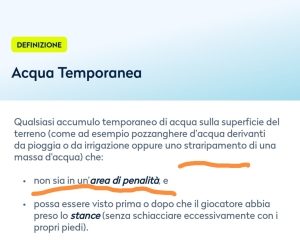
the answer can be found directly in the definition of temporary water.
Since the overflow, as Nicoletta explained, was outside the penalty area and the ball was lying there, relief is taken for temporary water under Rule 16.1b.
Antonio’s Question
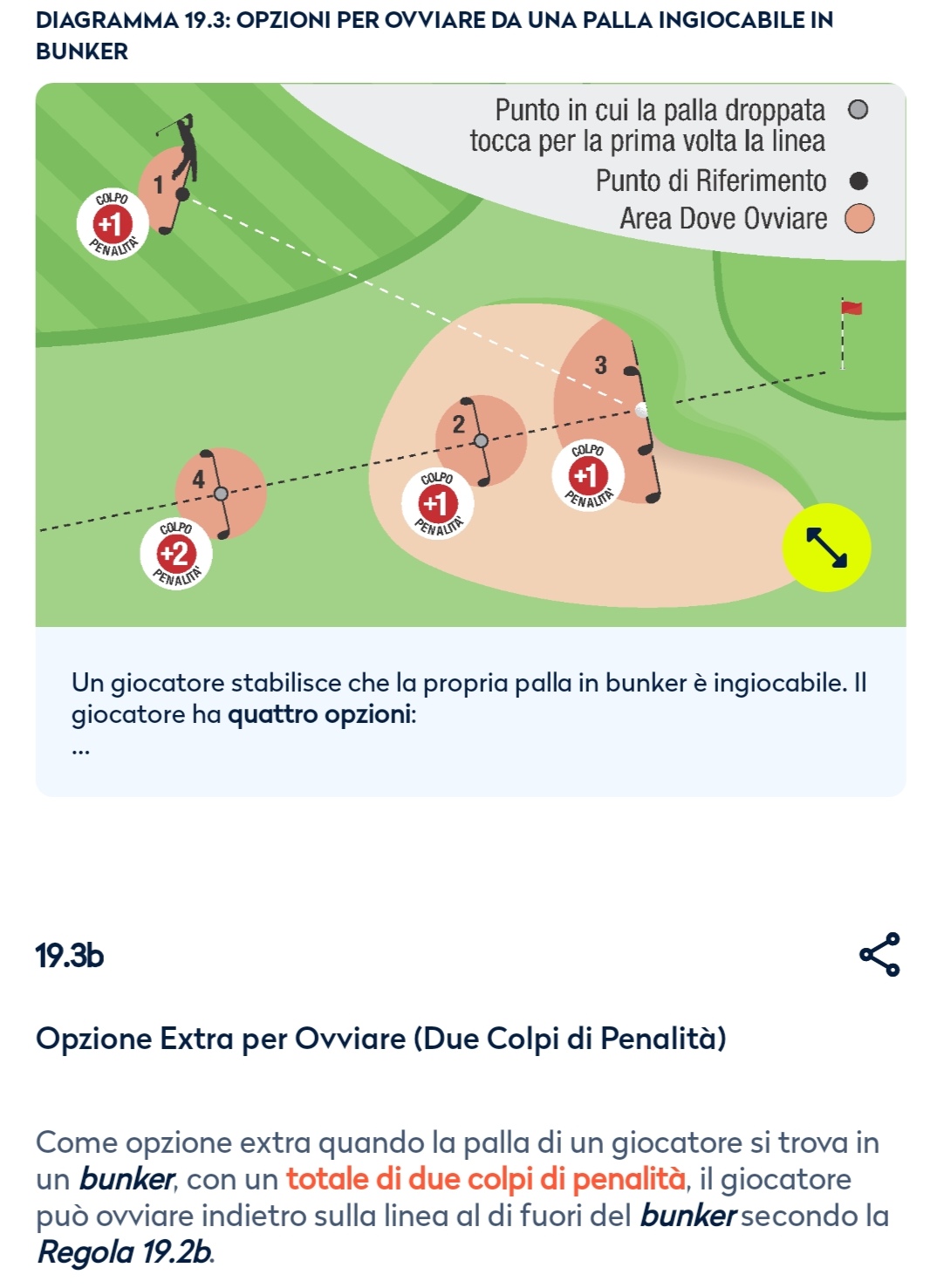
My ball is lying in a bunker, under the lip and embedded in the sand.
I decide to declare the ball unplayable.
What options and procedures can I apply, and how many penalty strokes do I add if I choose to take relief outside the bunker?
Thank you!
The Referees’ Answer
Thank you very much for your question.
The best way to explain it is by attaching a graphic that, in my opinion, clearly illustrates the different situations that may occur when declaring a ball unplayable in a bunker.
Domenica’s Question
During a club competition where preferred lies (“lift, clean and place”) were in effect, my ball was lying on the collar.
Meanwhile, my playing partners played their approach shots. When it became my turn, I replaced my ball and played my shot.
After finishing the hole, the referee questioned the fact that I had not replaced the ball immediately.
I would kindly like some clarification on this rule, as I was not aware of it.
Thank you in advance.
The Referees’ Answer
Good morning Domenica,
as you mentioned, the “preferred lies” local rule was in effect. This means you were allowed (even without marking the ball) to lift it, clean it, and then place it back within one scorecard length from where it originally lay when it was your turn to play.
If that is what you did, there is no penalty.
Mauro’s Question
If a ball is accidentally touched during an approach shot practice swing (while making a practice motion near a bunker close to the green),
is it considered a stroke in every respect, or can the ball simply be replaced without penalty?
The Referees’ Answer
Hi Mauro,
since there was no intention to strike the ball, this cannot be considered a stroke.
However, causing the ball to move results in a one-stroke penalty, and the ball must be replaced.
If the ball is not replaced and is instead played from where it came to rest, the penalty becomes two strokes for playing from a wrong place.
Francesco’s Question
Hi guys!
Here’s my question: during an 18-hole competition played on a 9-hole course, after holing out and completing the hole, I hit another putt to better understand the green.
Is this allowed even if I will have to play that same hole again during the second loop?
The Referees’ Answer
Hi Francesco,
that’s a very interesting question because it raises the issue of practice strokes during a round.
Rule 5.2b helps us here, as it specifically allows the type of practice you described, including practicing on the putting green even if you will play that hole again later the same day.
Mattia’s Question
Dear Referees,
I would like to describe a situation that happened to me while playing hole number 2 at Riviera Golf.
We were a flight of four players, playing for a beer.
After a decent drive, with my ball in the middle of the fairway about 145 meters from the hole, under slightly heavy ground conditions and with a light north-northeast wind, clear skies, and the sun low on the horizon limiting visibility, I played my second shot with a 7-iron aiming for the green.
Unfortunately, the strike was not perfect and, despite hitting the ball firmly, it took a very strange trajectory toward the right side of the course, near the lake by the small bridge connecting the 2nd green to the 3rd tee.
We all saw the ball hit something and bounce off with a difficult-to-follow trajectory, but to everyone it seemed to continue toward the green.
Unable to understand exactly where the ball had ended up — especially because we were playing into the sun — and since nobody saw a splash in the water, both my playing partners and I assumed that the ball had not gone into the lake.
Since I was not certain I would be able to find it, I declared and played a provisional ball.
I played it, and the ball finished near the edge of the green in a clearly visible position.
Once we reached the area where the original ball might have been, I started searching with the help of my fellow players.
After the three allowed minutes had passed — perhaps even slightly more, though we were not timing it exactly — and still unable to find the original ball, I prepared to play the provisional ball, which according to the Rules had now become the ball in play.
I then played from the edge of the green and left the ball about 1.5 meters from the hole.
With the following stroke, I holed out and was the first to finish the hole, but… as I bent down to retrieve the ball from the hole, I noticed that underneath it was the other ball — the original ball I had played with my second shot and that we had never found.
If such a situation happened during a competition, what score should I record on the scorecard?
The Referees’ Answer
Dear friend,
first of all, congratulations on the excellent description of what happened and of the procedures you followed.
In essence, you completed the hole in two strokes because you had already holed out. Everything else no longer counts, since the hole was already finished.
The strokes played with the provisional ball do not count as practice strokes either.
So congratulations on the fortunate eagle!
Alessio’s Question
Hole 7: my tee shot goes to the right of the lake, but not into the water. The ball cannot be found, and the group behind us is already on the tee, so my playing partners tell me to drop as if the ball were in the water, in order to speed things up.
I play the shot and immediately afterwards I find my original ball. What happens now?
The Referees’ Answer
Hi Alessio,
the situation you describe would need to be examined “on site” in order to fully understand what happened.
First of all, you are allowed three minutes to search for your ball, and nobody can deny you that time. If the group behind you was already ready to play, you could have let them play through so that you could continue searching for your ball.
From what you say, you saw your ball go to the right of the lake on hole 7, but not into the water. What did your playing partners see?
If your playing partners also saw the ball finish to the right, but not in the water, they could not allow you to drop “as if it were in the water” just to speed things up, because it was not known or virtually certain that your ball was in the water.
If, on the other hand, they were sure the ball was in the water, then perhaps you had seen it incorrectly and relied on their certainty. In that case, you acted correctly: having put another ball into play under the water relief procedure, you would continue with that ball, adding one penalty stroke.
In the first case, however, the situation becomes more complicated because you used a Rule that was not applicable. You should have gone back and played from where the previous stroke was made, adding one penalty stroke.
At this point, the actual situation on the hole would need to be clearly understood in order to give a definitive ruling.
Carmine’s Question
In situations where, due to course conditions, the ball may be placed on the fairway, is it allowed to clean and/or dry the ball without penalty?
The Referees’ Answer
Dear Carmine,
before placing the ball, it may be cleaned, dried, and even substituted without penalty.
Carmine’s Question
If the original ball is found after playing a provisional ball, but within the three-minute search time, can play continue with the original ball without penalty?
The Referees’ Answer
Dear Carmine,
after playing a provisional ball, you have three minutes to search for the original ball starting from the moment you arrive at the area where you believe the original ball may be.
If the original ball is found within those three minutes, the provisional ball must be abandoned.
Carmine’s Question
If a ball goes into the water, relief may be taken by dropping the ball outside the penalty area. If a mistake is made when repositioning the ball, can the situation be corrected by placing the ball properly without penalty?
The Referees’ Answer
Dear Carmine,
when taking relief from a penalty area, the ball must be dropped within the designated relief area.
If, after the first drop, the ball rolls outside the relief area, it must be dropped again.
If, after the second drop, the ball once again rolls outside the relief area, the ball must then be placed on the spot where it first touched the ground during the second drop.
Carmine’s Question
If the ball ends up in a bunker in a difficult position, can it be lifted, cleaned, and replaced without penalty?
The Referees’ Answer
Dear Carmine,
No. If the ball is in a difficult position inside a bunker, you must either play it as it lies or declare it unplayable with a one-stroke penalty.
With a two-stroke penalty, you may also take relief outside the bunker.
Roberto’s Question
Is it allowed to check the putting line before making the stroke without stepping away from your stance afterward?
The Referees’ Answer
Dear Roberto,
it is important to clarify whether the player is reading the line independently and then simply playing the stroke, or whether the player is being assisted by a caddie or playing partner.
In the latter case, the player must step away from the stance before making the stroke, once the caddie has moved away after indicating the line of play.
Daniele’s Question
While playing hole 2, I hit my ball toward the hazard on the right side of the fairway. I went to look for it but couldn’t find it. My marker told me there was “evidence” that the ball had entered the water, even though we didn’t actually see it go in. Was he allowed to do that?
The Referees’ Answer
Dear Daniele,
starting with a joke, we should say that the marker does not have the power of life or death over the player — their role is simply to certify the player’s score together with the player.
Coming back to your question, what is still often called “evidence” should actually be referred to as “known or virtually certain” (100% or at least 95% certain). Only when this level of certainty exists can it be concluded that the ball entered the penalty area.
In your case, since that certainty did not exist, if the ball is not found within the penalty area during the three minutes allowed for searching under the Rules, the ball must be considered lost.
Luigi’s Question
When the “preferred lies” rule is in effect, can I change the ball?
The Referees’ Answer
Dear Luigi,
Yes, you may change the ball.
However, it is important to remember that once the ball has been placed, it is in play and may not be placed again.